


The Return of the Useful Object: Thoughtful Fashion Design


Why usefulness, repeat use, and long-term relevance are becoming more important to the products we choose to keep.
A product does not become valuable simply because it is new.
Some objects earn their place differently.
They become useful enough to be used repeatedly, understood intuitively, and eventually difficult to replace. In a culture where products increasingly compete for attention, usefulness offers another form of value.
The question is no longer only whether something can attract us.It is whether it can become part of our lives.
A useful object is not simply an object that performs a function. It is a product that can become part of repeated, ordinary use, reliable enough to trust, simple enough to understand, and relevant enough to keep.
What Makes an Object Useful?
Usefulness is not simply about what a product does.
It is about whether people can naturally make it part of their routines.
A useful object solves a recurring need. It is easy to understand and easy to use. It performs reliably enough that the user does not have to constantly negotiate with it. It can be repeated without becoming a burden. And it remains compatible with the conditions of everyday life — movement, weather, other objects, changing contexts.
Technical function is only one part of this. An object can be technically capable and still fail to become useful if it is difficult to live with.
Some of the most successful everyday objects disappear into use rather than demanding constant attention.
Utility Is Not the Opposite of Design
Function and aesthetic are often treated as opposing forces. One is practical; the other is expressive. One solves problems; the other creates desire.
This separation is incomplete.
A well-designed object can carry function, material character, proportion, and visual identity at the same time. When these elements agree, the product becomes easier to understand and easier to remember. Form does not have to hide function, and function does not have to reject form.
The most enduring objects are rarely pure statements of either.
They are resolved relationships between what something does and how it exists in space and on the body.
Why Everyday Objects Matter More Than Occasional Objects
Occasional objects are often encountered through display, presentation, or special circumstances.
They can be admired, photographed, and remembered for a particular moment.
Everyday objects operate differently. They are touched, carried, worn, washed, moved, combined, and repeated.
They accumulate meaning through use rather than through spectacle.
Because they occupy so much of lived time, everyday objects have a particular cultural weight. Their quality, or lack of it, is experienced continuously rather than occasionally. When an everyday object works well, it becomes part of the background structure of a person’s life. When it fails, the friction is equally constant.
Use Changes the Meaning of a Product
A product begins as a commodity.
Once it enters use, its meaning begins to change.
Through repetition it becomes familiar.
Through reliability it becomes trusted.
Through continued presence it can eventually become personal.
This progression is not automatic. Many products remain temporary. They are used a few times, noticed, and then replaced. Others survive long enough to move from being “a product I bought” to “an object I rely on.”
Product value does not end at purchase. Some of it is created afterward, through the quiet accumulation of use.
Familiarity Can Be a Form of Product Strength
Newness attracts attention. Familiarity generates a different kind of value.
A product that becomes easier to choose over time may be more deeply integrated into a person’s life than a product that demands constant re-evaluation. Confidence, ease, recognition, and the absence of decision fatigue are all forms of strength that only appear after repeated contact.
This does not mean that newness is without value. Newness and familiarity simply serve different roles. One opens possibility. The other stabilizes it.
A culture that only rewards the first eventually loses the second.
Why Fashion Needs Useful Products
Clothing sits at the intersection of expression, identity, utility, and social meaning.
In contemporary fashion design, the interesting question is not whether clothing can be functional. It is whether usefulness can become part of the reason a garment becomes culturally meaningful.
The more interesting question is not whether clothing can be functional. It is whether usefulness can become part of the reason a garment becomes culturally meaningful.
When a piece of clothing is designed to perform reliably across repeated wear, different contexts, and changing conditions, it begins to operate as more than a seasonal signal. It becomes an object that people return to, not because it is constantly new, but because it continues to make sense.
The T-Shirt Is an Unusually Difficult Useful Object
Few garments are as frequently used as the T-shirt.
It is worn repeatedly, washed repeatedly, layered, combined, moved in, traveled in, worked in, and lived in. There is very little space for unresolved decisions to hide. Proportion, material, construction, recovery, and comfort are tested continuously rather than occasionally.
The simpler the product appears, the more exposed its unresolved decisions become.
This is why a well-resolved T-shirt is more difficult to achieve than it first appears, and why the category remains one of the clearest tests of whether a product has been designed as an object or merely as a surface for expression.
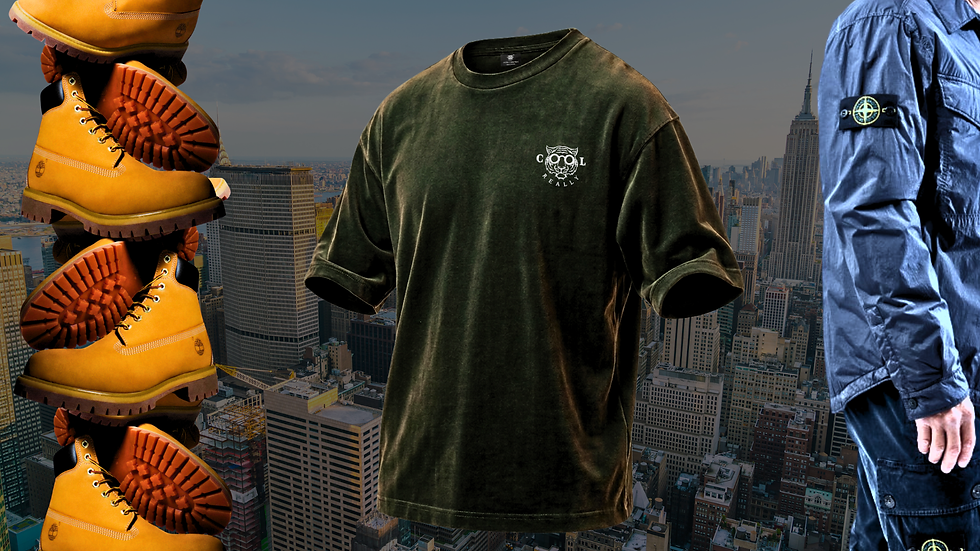
Why REALLY COOL® Looks at Essentials as Objects
REALLY COOL® focuses on essentials because the design quality of a simple garment is difficult to conceal.
When decoration and complex visual noise are reduced, what remains is the coherence of the object itself: material character, proportion, construction, movement, and the ability to survive repetition. The product has to work before it can become meaningful.
This is why the questions of object, proportion, material presence, and fit are treated as foundational rather than secondary. They determine whether a garment can move from being noticed to being used, and from being used to being kept.
Useful Does Not Mean Boring
A useful object is not required to be plain, industrial, or visually mute.
It can carry distinct materiality, clear proportion, and recognizable character. The difference is that these qualities support the object’s role rather than competing with it. The product becomes desirable for what it is, how it feels, how it sits, how it continues to perform, rather than solely for what it signals in a single moment of attention.
Usefulness and identity are not mutually exclusive. When they reinforce each other, the object gains a quieter but more durable form of presence.
The Standard of Earning a Place
The return of the useful object is not a return to boring products.
It is a return to products that have to earn their place.
An object becomes meaningful when it is used enough to become familiar, trusted, and eventually difficult to replace. In clothing, that standard may be even more demanding because garments live directly on the body and inside everyday routines.
Not merely to be noticed.
To be useful enough to be remembered.


Comments