


What We Mean by Lifestyle Engineering

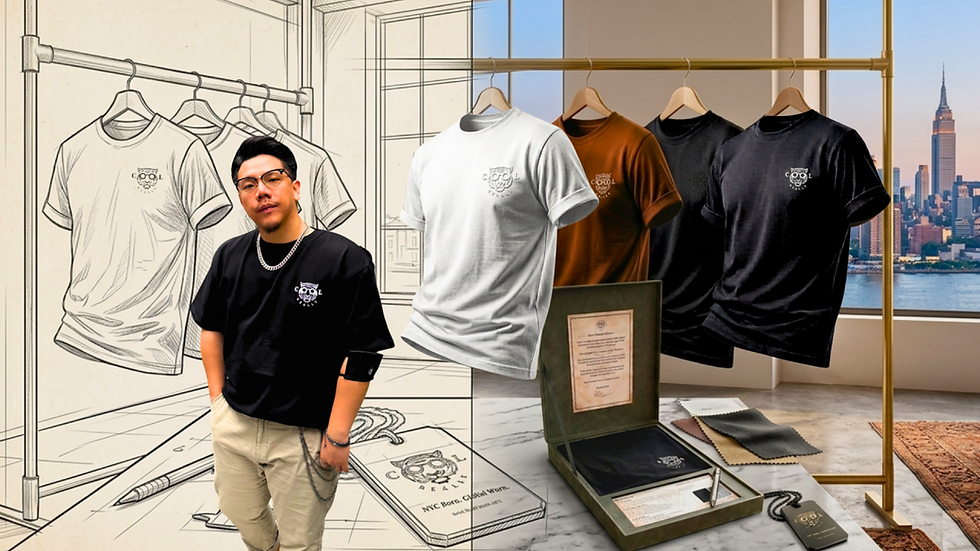
Cities ask a great deal from clothing.
A garment moves through commutes, work, travel, studios, late nights, crowded rooms, changing weather, and repeated wear. It is handled, folded, washed, packed, layered, and worn again.
For us, that is where product design begins.
At REALLY COOL®, we call this approach Lifestyle Engineering.
It is not about turning everyday clothing into equipment. It is about taking everyday use seriously. We are interested in how material, construction, proportion, and surface character can work together to make an essential feel more considered over time.
A premium garment should not require a protected life. It should be able to take part in one.
Clothing for Repetition, Not Occasion
Fashion has always had a complicated relationship with everyday life.
Some garments are designed around the moment: the photograph, the runway, the release, the occasion. Others are designed to disappear into a wardrobe and become part of a person's routine.
We are more interested in the second category.
The pieces that matter most in a wardrobe are rarely the ones that demand attention every time they are worn. They are the ones that become familiar without becoming ordinary. They move between places and situations without asking the wearer to change who they are.
That changes the way we think about design.
A garment intended to be worn repeatedly has to deal with conditions that a product designed only for presentation does not. It has to move with the body. It has to tolerate washing. It has to hold its proportions. It has to remain comfortable when the day becomes longer than expected. It has to make sense with the rest of a wardrobe rather than exist only as a complete look.
These are not secondary considerations.
They are the product.
This is one reason we have always been drawn to the history of workwear, uniforms, military garments, and street culture. Their significance was never simply visual. They were shaped by the demands of real environments and gradually became cultural objects because people gave them meaning through use.
We believe contemporary essentials can learn from that relationship between function and culture without simply reproducing the past.
Beyond the Language of Status
For decades, fashion has become exceptionally good at communicating status.
The logo. The limited release. The collaboration. The association with a particular cultural moment. The sense that something is difficult to obtain.
None of these things are inherently wrong. They are part of how fashion creates culture.
But recognition and usefulness are not the same thing.
As premium apparel becomes increasingly crowded, the physical experience of a garment matters more. Consumers can recognize a compelling image in seconds. What is harder to manufacture is the feeling that a product deserves a permanent place in someone's life.
That feeling does not come from one detail.
It comes from accumulation.
The weight of the fabric. The way the shoulder falls. The proportion of the body. The resistance of a collar. The texture under the hand. The way the garment changes after repeated wear. The confidence of knowing that it will still make sense a year from now.
This is where we see an opportunity for premium essentials.
Not to make basics louder, but to make them more intentional.
At REALLY COOL®, we are interested in the space between cultural expression and physical permanence. The garment should have enough character to be recognized, but enough restraint to remain useful.
It should be able to exist within fashion without becoming dependent on fashion.
Material Is Part of the Experience
Material is often discussed as a specification. GSM. Fiber composition. Yarn count. Finishing. Shrinkage. Strength.
These measurements matter. But the reason they matter is what happens after the garment leaves the factory.
Weight changes how a garment feels before it is even worn. Construction changes how that weight behaves once it is on the body. Finishing changes how the surface responds to light and touch. Density influences how the garment holds itself, while the underlying knit structure influences how it moves.
This is why our development of 420 GSM high-density single jersey was never simply a pursuit of heavier fabric.
The question was more fundamental:
How much structure can a single-layer jersey achieve while still retaining the movement, texture, and physical character that make jersey worth wearing?
That question led us into material development, construction, finishing, and testing as one connected process rather than four separate stages.
The result is what we call the Tactile Paradox™: a garment with substantial structural presence that remains connected to the natural movement of the body.
For us, this is where engineering becomes meaningful.
Not when a specification looks impressive on paper, but when the specification changes the experience of wearing the garment.
We go deeper into that development process in:
Product Architecture for Real Life
Material alone cannot create a great garment.
The same fabric can produce completely different experiences depending on how it is cut, assembled, reinforced, and proportioned.
This is why we think about clothing as an architecture.
The shoulder is not simply a seam. It determines how the garment frames the body.
The neckline is not simply an opening. It influences how the entire upper silhouette holds itself.
The hem is not simply a finishing point. Its relationship with the shoulder, chest, and length determines whether the garment feels balanced or unresolved.
Even small construction decisions accumulate into something the wearer experiences as one thing: the garment.
This is particularly important with oversized and boxy silhouettes.
A larger proportion does not automatically create a better oversized garment. Without control, additional volume can become excess rather than structure. The objective is not simply to add fabric. It is to establish a proportion that feels intentional from every angle.
That is why our product architecture begins with the relationship between material and silhouette rather than treating them as separate decisions.
The fabric informs the pattern.
The pattern informs the construction.
The construction informs how the garment moves.
And the way it moves ultimately determines whether the product feels right in real life.
Why We Call It Lifestyle Engineering
The phrase Lifestyle Engineering came from a simple observation: clothing is used under conditions that designers cannot completely control.
We cannot predict where someone will wear a garment tomorrow.
It might be a studio in Brooklyn, a train in Tokyo, a café in Singapore, a gallery in London, a flight across continents, or simply a long day walking through a city.
We can, however, design around the common conditions.
Movement.
Repetition.
Pressure.
Weather.
Washing.
Layering.
Time.
Lifestyle Engineering is our approach to considering these conditions from the beginning of product development.
It means looking at material behavior alongside movement, proportion alongside comfort, durability alongside appearance, and construction alongside repetition.
It does not mean adding complexity for the sake of complexity.
In fact, the opposite is often true.
The better the engineering, the less the wearer should have to think about it.
A collar should simply hold its shape.
A silhouette should simply feel balanced.
A fabric should feel substantial without becoming unnecessarily restrictive.
A garment should become easier to wear, not more difficult, as it becomes more considered.
That is the standard we are pursuing.
A More Considered Essential
We do not believe the future of premium apparel depends on making everyday clothing more complicated.
It depends on making it more considered.
The next generation of essentials will not necessarily be defined by how aggressively they announce themselves. They may be defined by how well they integrate into the lives of the people wearing them.
That requires a different kind of design discipline.
It means thinking beyond the first impression and asking what happens after the tenth wear, the twentieth wash, the long journey, the late night, or the season when the garment becomes familiar.
It means understanding that durability is not simply a technical attribute. It is part of emotional value.
A garment that continues to feel right earns something that marketing cannot manufacture: trust.
That is ultimately what we want REALLY COOL® to build.
Not disposable products designed around the rhythm of seasonal consumption, but a system of premium essentials with enough physical integrity, cultural character, and restraint to remain relevant beyond the moment in which they were introduced.
Lifestyle Engineering is our way of putting that belief into practice.
We design around real life because that is where clothing ultimately has to prove itself.
Not on the screen.
Not on the runway.
Not on the hanger.
On the person.
We don't design for titles. We design for lives.
NYC Born. Global Worn.
By Willy Kuo, Founder & CEO of REALLY COOL®

Comments